Learn about how to create a strategy for a successful data warehouse migration.
One of the first tasks your migration team should agree upon to execute a smooth migration process is the migration strategy. Depending on the migration project requirements, the timeframe for completion, and various other factors, you can use an iterative approach or a Big Bang approach.
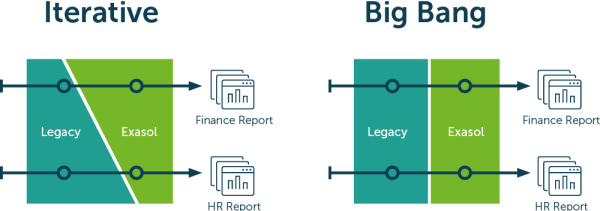
Iterative staged approach
The data warehouse is migrated in small increments over time on a per-subject area basis. Each subject area consists of integrating the data sources needed to fulfill the analytic requirements (such as reports or dashboards) of a specific business area like Sales or Marketing.
Top reasons for choosing an iterative staged approach:
- You can show value to end users very early by migrating data marts that suffer most from problems such as low performance
- As part of your data warehouse modernization, you can change the ETL tool or BI reporting tool
- Each iteration is a learning opportunity and improves the migration of the next subject area
If you have a Kimball style data model the iterative approach fits very well since you can map to the different data marts that serve a specific subject area.
Big Bang approach
The data warehouse is migrated in a single operation.
Top reasons for choosing a Big Bang approach:
-
You have a highly integrated data model that makes it difficult to split the migration into smaller iterations
-
To eliminate the costs of your legacy vendor, you must migrate before a contract renewal
-
During the assessment phase, you have concluded that the migration has low risks and no significant obstacles.
This might be the case if, for example, you do not have to migrate a lot of SQL statements with
