Learn how to migrate users, roles, and access permissions from Oracle to Exasol.
Differences in rights management
Every schema in Oracle is related to a corresponding user. This means that not every user in the Oracle database has to be migrated when you are migrating into Exasol.
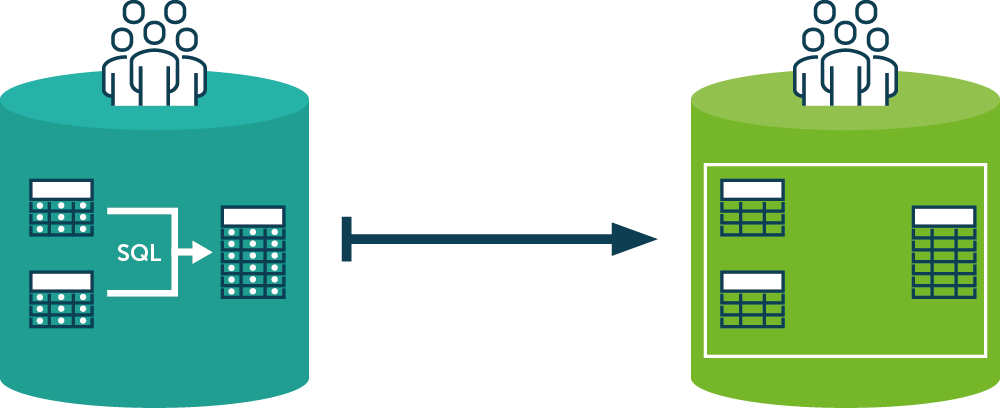
The rights management in Oracle covers indexes, tablespaces, materialized views, and ALTER PROCEDURE for recompiling the procedures in Oracle. These are not needed and therefore not supported in Exasol. Most of the privileges for overlapping objects between Oracle and Exasol, such as tables and views, can be mapped easily.
In Oracle, granting the right to select from all the tables within a schema to a user/role requires grants on every individual table explicitly. This must be done for new tables as well as recreated/replaced tables.
GRANT SELECT ON "C##DB_MIG"."SALES" TO CORE_RO;
GRANT SELECT ON "C##DB_MIG"."STORES" TO CORE_RO;
GRANT SELECT ON "C##DB_MIG"."CUSTOMERS" TO CORE_RO;
This can be done on a schema level on Exasol, so that even future tables do not have to be manually included.
GRANT SELECT ON "C##DB_MIG" TO CORE_RO;Checking users, roles, and rights
To get information about the users/roles and privileges in the Oracle database, you can use the following queries in the Appendix section:
- To get an overview of the privileges granted to users/roles:
- Appendix F: Privileges granted to roles/users
- To get an overview which roles users have:
- Appendix G: Users and their roles
- To get an overview of the system privileges of users/roles
- Appendix H: System privileges
Further reading
For more details about rights management in Exasol and Oracle, see the following resources:
- Details on rights management
- Resource manager
- GRANT in the Oracle documentation
